AI agents that execute work: Beyond analytics to action
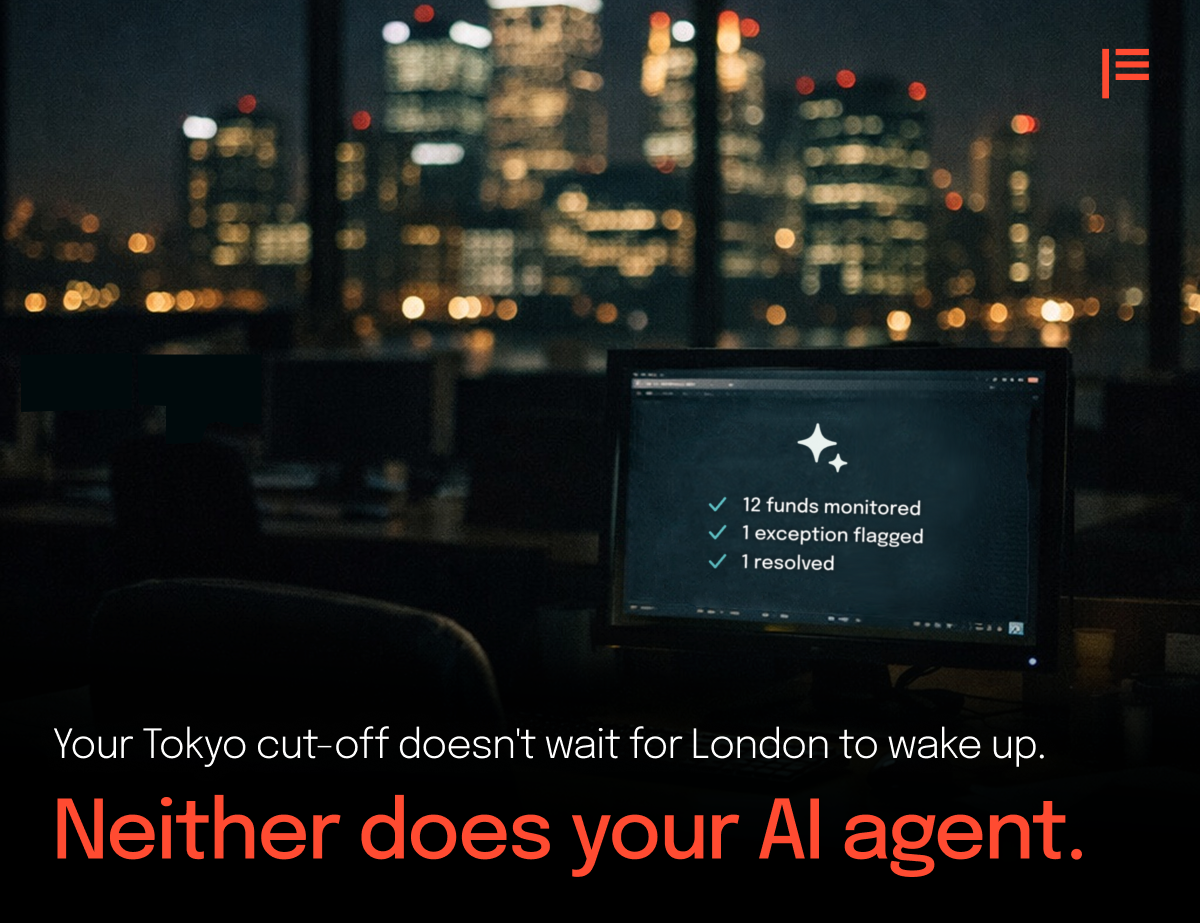
The distinction between AI that analyses and AI that acts represents the most significant shift in how technology supports asset servicing operations. Most discussions about artificial intelligence still focus on analytical capabilities1: identifying patterns, flagging anomalies, generating insights. Whilst valuable, this captures only part of what’s becoming possible.
AI agents that execute work represent a different category entirely.2 They don’t just recommend actions or highlight issues. They complete operational tasks autonomously within defined parameters, operating more like digital colleagues than analytical tools. Understanding this distinction matters because it changes what’s achievable operationally and how teams can be structured.
What makes an AI agent different
An AI agent in asset servicing receives instructions and based on its remit, determines required steps, executes them across multiple systems, handles exceptions within its scope, and escalates when circumstances exceed its parameters.
This differs fundamentally from traditional workflow automation. Rules-based automation follows predetermined paths3: if this condition exists, then execute that action. AI agents operate more flexibly than traditional automation, interpreting intent and adapting their approach within defined boundaries; similar to how a human colleague adjusts when circumstances vary, but still within the scope of their role.
Consider reconciling a cash position. Traditional automation might match transactions between two sources based on exact criteria. An AI agent approaches this differently. It understands that the same economic event might be described differently across systems. It recognises that timing differences don’t necessarily indicate discrepancies. It knows which variations matter and which represent expected differences.
The agent doesn’t just identify breaks. It investigates them, checking reference data, examining related transactions, considering timing sequences. When it determines the cause and resolution falls within its authority, it acts. When something appears unusual or complex, it escalates to human colleagues with context about what it found and why it requires attention.
Natural language as the interface
Perhaps the most significant characteristic of AI agents is how people interact with them. Rather than configuring complex workflows or writing code, you communicate in natural language.
This transforms who can leverage AI capability. Previously, creating automation required technical expertise: understanding system integrations, writing scripts, configuring workflow engines. AI agents shift this. An operations professional can describe what they need accomplished, and the agent determines how to execute it, dependant of course on the remit of the particular agent.
“Reconcile yesterday’s cash movements for the European equity funds and highlight anything that doesn’t clear within standard parameters” becomes a simple instruction rather than a technical specification. The agent understands the intent, accesses necessary data sources, performs the reconciliation, and presents results.
This democratises technological capability in meaningful ways.4 Business users who understand operations don’t need technical intermediaries to create or modify processes.5 When requirements change or new needs emerge, adjustments happen through conversation rather than development cycles. For well-scoped changes to existing agent workflows, the gap between identifying what needs to happen and making it happen collapses from weeks to minutes.
Real workflows where agents add value
Reconciliation processes represent the most immediate opportunity.6 Fund administrators perform countless reconciliations: cash positions, securities holdings, transaction records, NAV components, client reporting. AI agents handle routine elements exceptionally well. They perform comparisons, recognise common variation types, resolve straightforward breaks, and escalate genuine discrepancies with relevant context. Teams focus on exceptions that genuinely require human judgement.
Exception handling workflows benefit similarly. When exceptions arise, someone must investigate, determine the cause, and resolve it. Many exceptions follow familiar patterns: missing reference data, timing differences, standard corporate actions, predictable client-specific variations. Agents learn these patterns and handle familiar exceptions autonomously.7 The knowledge base builds progressively.
Reporting processes involve gathering data from multiple sources, applying client-specific formatting, performing calculations, and producing outputs. Agents orchestrate these processes, pulling data from wherever it resides, applying necessary transformations, and producing outputs that meet specifications. When clients request modifications, instructions come through natural language rather than technical change requests.
Data validation workflows before and after critical processes benefit from AI agents. Rather than humans checking that inputs meet expected criteria or outputs appear reasonable, agents perform these validations consistently, flagging anything outside expected patterns for human review.
The human and agent collaboration model
The most effective application of AI agents isn’t maximum automation. It’s optimal collaboration between human expertise and AI capability.8
Agents excel at consistency, speed, and pattern recognition at scale: running reconciliations across every fund simultaneously, monitoring settlement fails for penalty exposure, flagging price anomalies across hundreds of positions. Humans excel at the situations that demand judgement: an ambiguous corporate action where data vendors disagree, or a new fund structure where the legal terms carry more than one defensible interpretation.
The productive model has agents handling routine work whilst escalating complexity. A reconciliation agent processes thousands of standard matches, allowing humans to focus on the 2% that genuinely require investigation. An exception handling agent resolves familiar issues, giving teams capacity to address unusual situations requiring deeper analysis.
This transforms team capacity. Rather than spending 80% of time on routine work and 20% on value-adding activities, the ratio inverts.9 Operational teams can focus on improvement, client service, and handling genuinely complex situations whilst agents manage repetitive elements.
The operational transformation potential
When AI agents execute work effectively, they enable different operational models entirely.
Teams can scale capacity without proportional headcount increases.10 Client onboarding processes that required dedicated resources can run largely through agent orchestration. Service expansions that seemed operationally prohibitive become feasible when agents handle execution.
The economics of servicing complexity change. Operations that required significant manual intervention per transaction can run with agents managing routine elements. This shifts which mandates you can pursue profitably and what service levels you can commit to commercially.
Perhaps most significantly, agents create capacity for improvement. When teams aren’t consumed by routine execution, they can focus on optimising processes, developing new capabilities, and serving clients more effectively. The compounding effect over time is substantial.
The shift from AI that analyses to AI that executes work is the distinction that matters in asset servicing operations today. Reconciliation, exception handling, reporting, validation: agents are already handling these reliably where the conditions are right. The servicers who act on this will not simply reduce cost per transaction. They will expand what is operationally feasible, and that changes the terms on which they can compete.
This article is part of our asset servicing insight series

Citations
1Top use cases remain analytical: data extraction (92%), document summarisation (85%), compliance (69%). Deloitte 2025 AS Survey, p.27–28
2No survey respondents mentioned agentic AI — noted as “surprising, given its potential.” Deloitte 2025 AS Survey, p.25–26
379% cite manual workflows and lack of standardisation as their key hurdle. Only 21% have most processes digitalised. EY Benchmarking 2025, p.6, 10
4GenAI already deployed for client communications and documentation — early natural-language operational use cases. EY Top 5 Trends, p.6
5Only 8% cited technical skills availability as a top-three delivery challenge — the bottleneck is requirements clarity, not expertise. Deloitte 2025 AS Survey, p.19–20
6Firms targeting hyper-automation via RPA, AI and workflow orchestration for reconciliation and anomaly detection. Deloitte 2025 AS Survey, p.15–16
769% identify fraud/anomaly detection as a GenAI use case; 92% prioritise operational workflow automation. Deloitte 2025 AS Survey, p.27–28
8EY: use AI to “enhance and not replace human oversight.” Deloitte places augmented processing (AI + human review) as the production-ready tier. EY Top 5 Trends, p.7; Deloitte 2025 AS Survey, p.25–26
9>78% expect AI to eliminate repetitive tasks. EY projects zero-touch operations targeting >70% hyper-automation. Deloitte 2025 AS Survey, p.29–30; EY Benchmarking 2025, p.20
10Offshoring budget forecast to drop from 13% to 7% by 2030, driven by automation/AI replacing non-core manual activities. Deloitte 2025 AS Survey, pp.39–40