Escaping integration hell: From point-to-point to platform architecture
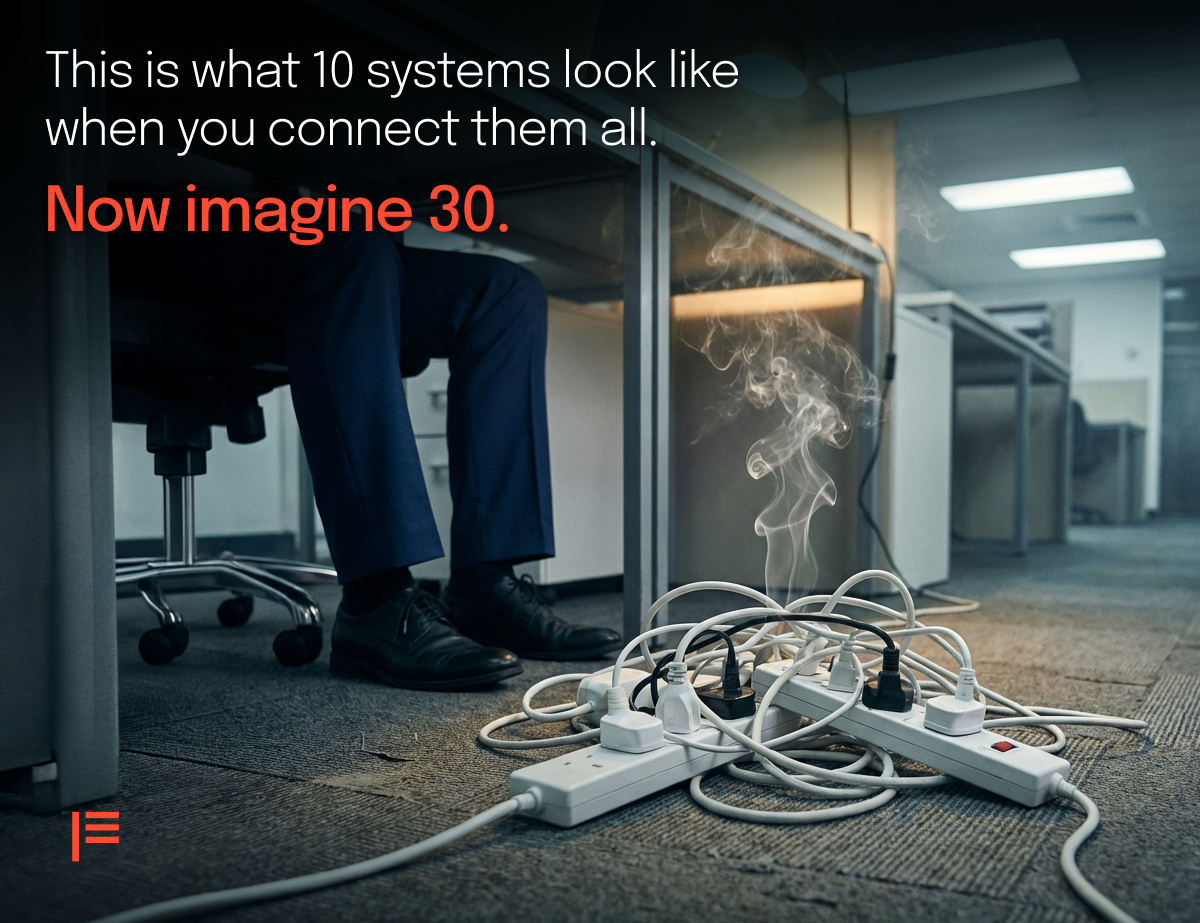
Most asset servicers don’t set out to build integration nightmares. They begin with sensible decisions: selecting best-of-breed systems for specific functions, adding capabilities as business needs emerge, connecting systems to enable data flow. Each decision makes sense in isolation. The accumulated effect creates something else entirely.
The result is integration hell; dozens or hundreds of point-to-point connections, data inconsistencies requiring constant reconciliation, changes in one system cascading unpredictably through others, and new capabilities taking months to implement because of integration complexity.1
Understanding why this happens, and recognising alternative architectural approaches, increasingly matters as these technical foundations determine what servicers can accomplish strategically.
The point-to-point trap
Integration complexity doesn’t emerge overnight. It accumulates through reasonable responses to immediate needs.
A servicer needs better portfolio accounting, so they implement a specialist system. Client reporting requirements evolve, so they add a reporting tool. Regulatory obligations change, so they deploy compliance software. Each addition solves a genuine problem. Each also creates integration requirements with existing systems.
The mathematics of point-to-point integration are unforgiving. With three systems, you need three connections. With five systems, you need ten connections. With ten systems, you need forty-five connections. The complexity grows exponentially, not linearly.
What’s less obvious is how this architecture constrains everything else. Want to add a new capability? First, map all the integration requirements. Need to upgrade a system? Test every connected system for unintended consequences. Client requests a new data field? Trace it through multiple systems and connections to ensure consistency.
Teams spend enormous time managing integration complexity rather than delivering value. Technology budgets shift towards maintenance rather than innovation.2 The pace of change slows whilst the cost accelerates.
Why data becomes the central problem
The deeper issue isn’t connections between systems. It’s what happens to data as it moves through these connections.
Each system maintains its own data model, its own definitions, its own logic. A position in your portfolio accounting system might be structured differently than in your reporting system. Trade dates, settlement dates, and valuation dates might follow different conventions across systems. Client hierarchies might be organised differently depending on which system you’re viewing.
This creates constant reconciliation requirements.3 Teams spend hours investigating discrepancies that stem from definitional differences rather than actual errors. Month-end closes extend because data must be verified across multiple systems. Client queries require checking several systems to understand the complete picture.
The reconciliation burden grows with each system added. More significantly, confidence in data erodes. When different systems provide different answers to what should be the same question, which do you trust? How do you explain discrepancies to clients? How do you make decisions based on data you’re not certain about?
The architecture alternative
Platform architecture approaches these challenges fundamentally differently. Rather than connecting disparate systems, it unifies data and functionality within a coherent structure. The architectural principles matter more than specific implementations.
A unified data foundation replaces multiple siloed data models.4 Instead of data residing in numerous systems with different structures, there’s a single, consistent view. This doesn’t necessarily require moving all data physically. Data virtualisation techniques can create unified views whilst data remains distributed. The key is that every function, every report, every workflow operates from the same underlying data perspective.
This eliminates reconciliation requirements. There’s much less to reconcile when everyone works from the same data. It also rebuilds trust: when questions arise, you’re examining a single source rather than comparing multiple sources.
Standardised connectivity replaces bespoke integrations. Rather than custom integrations built for each specific connection, APIs provide consistent interfaces.5 Need to connect a new system? Use the API. Need to extract data for analysis? Use the API. Need to enable client portal access? Use the API.
This transforms integration from a project into a configuration exercise. New connections take days rather than months. Changes in one area don’t cascade unpredictably because interfaces are standardised and stable.
Cloud-native infrastructure changes scalability economics.6 Traditional on-premise infrastructure scales through hardware investment and capacity planning. Cloud-native approaches scale elastically based on demand. Processing requirements spike during month-end? Capacity scales automatically. Need to support geographic expansion? Deploy in new regions without infrastructure projects.
Integrated functionality reduces the vendor puzzle. Rather than assembling capabilities from multiple vendors and managing all the integration complexity this creates, platform approaches provide functionality spanning operational workflows within a unified environment. This doesn’t mean everything comes pre-built, but capabilities can be added within a consistent architecture rather than requiring integration projects.
What changes operationally
These architectural differences create tangible operational shifts that compound over time.
Configuration replaces customisation for many requirements. When client needs arise, functionality can often be configured rather than custom-developed. A new reporting structure, a different data view, a modified workflow; these become configuration exercises completed in days rather than development projects spanning months.
Change becomes manageable rather than terrifying. New regulatory requirements, evolving client demands, or strategic pivots don’t trigger cascading integration reviews. Changes happen within a unified environment where impacts are contained and predictable.
Innovation capacity increases. When technology teams aren’t consumed maintaining integrations and reconciling data, capacity emerges for improvement.7 The pace of innovation can accelerate because the architecture enables rather than constrains change.
Data becomes trustworthy. Single data models eliminate discrepancies and reconciliation requirements. Teams spend time analysing data rather than verifying it. Client conversations focus on insights rather than explaining inconsistencies.
Speed becomes possible. Client onboarding, service launches, and capability expansion can happen at fundamentally different speeds when architecture enables rather than constrains.
The migration reality
Understanding platform benefits is one thing. Migrating from point-to-point architecture presents different challenges.
The migration needn’t require simultaneous replacement of every system. Modern platform architecture can accommodate phased transitions. Existing systems can connect through APIs whilst functionality gradually migrates. Data virtualisation can enable unified views even when some data physically resides in legacy systems during transition.
This approach manages risk whilst delivering progressive benefits. Early migrations prove the concept and deliver immediate value. Subsequent phases build confidence and momentum. The transition becomes a managed evolution rather than a risky replacement.
The key is architectural commitment: deciding to move towards platform thinking rather than perpetuating point-to-point approaches. Once that direction is clear, the migration path becomes a series of manageable steps.
Questions worth asking
Rather than prescribing answers, examining your current position helps clarify whether architecture enables or constrains your strategy.
How many point-to-point integrations do you maintain? How much of your IT budget goes to maintaining these versus building new capabilities?8 How long does implementation of a new integration typically take? Can you add capabilities through configuration or does everything require development? How much time do teams spend reconciling data between systems? When clients ask for new reporting or data views, what’s the typical delivery timeline?
The answers reveal whether your architecture supports growth or constrains it. They clarify whether you’re building on a foundation that enables your strategy or managing technical debt that undermines it.
The architectural choice
Every servicer must choose its architectural direction, even if that choice is implicit in inaction. Continue managing point-to-point complexity with incremental improvements, or commit to platform architecture that fundamentally changes what’s possible.
Architecture isn’t about technology for its own sake. It’s about enabling the operational leverage, responsiveness, and strategic flexibility that determine competitive positioning.
The distinction between servicers thriving and those struggling will increasingly trace back to architectural choices made today. Not because architecture is the only factor that matters, but because it shapes every other capability you try to build.9
This article is part of our asset servicing insight series

Citations
1 83% cite interoperability across platforms as their most significant data challenge; 75% struggle with data variety and 67% with data volume. Deloitte 2025 AS Survey, p.17–18
2 Core systems modernisation consumes 20% of budgets today. Investment in innovation/digitalisation expected to rise from 27% to 38% by 2030 — but only once legacy constraints are addressed. Deloitte 2025 AS Survey, p.11–12
3 92% have siloed operating models; 82% say silos limit cross-departmental collaboration. Only 8% rate themselves ‘Leading’ in data platform maturity. Deloitte 2025 AS Survey, p.17–18, p.41–42
4 76% of asset servicers expect data platforms to have the biggest impact on operations (per TS comment). 74% identify data platform modernisation as a key priority. EY Lux Benchmarking 2025, p.13; Deloitte 2025 AS Survey, p.17
5 82% of F2B respondents plan open-ended architecture. Shift toward ‘Cross-Vendor Integrated’ models using multiple vendor integrations via standardised interfaces. Deloitte 2025 AS Survey, p.33–34
6 100% agree cloud enhances scalability; 83% cite efficiency and agility gains. 82% are running cloud projects, though 37% of work remains on-premise. Deloitte 2025 AS Survey, p.15–16
7 92% say legacy systems constrain innovation. 91% have established Centres of Excellence and 82% have dedicated transformation teams to redirect capacity. Deloitte 2025 AS Survey, p.13–14, p.19–20
8 Only 33% of servicers fully fund digital initiatives (down from 52% in 2024). Most firms allocate just 0–10% of revenue to digital projects. EY Lux Benchmarking 2025, p.8
9 Legacy technology is the #1 challenge for delivering F2B platforms (92%). 75% cite establishing clear requirements as the top project delivery challenge. Deloitte 2025 AS Survey, p.19–20, p.35–36